Tuesday, 31 May 2011

Silat Clip of the Month


Hello again.
Back again with my selection of cool clip of the month. One thing about my selections I select not on popularity or who as more students or who as the biggest business (Sorry group of clubs) But on who I think is generaly the real deal and viewers can see that I only select Gurus of true talent who have given back. Not just to their students but to the culture where these arts originated. This leads me into why this months clip is of my good friend Guru Eric Kruk. He is without doubt one of the last true Harimau gurus. What? but theres loads of teachers teaching Harimau,, right? wrong theres hundreds who claim to but theres MANY paper tigers out there and Eric is one of the last of the true Tigers. His skills are matched only by his generousity to those people in Indonesia he as helped with his orphanage visits he as a great group of guys and does a lot to give back to the culture and people we take from.
A big man a true Harimau. Heres to Guru Eric gods bless my friend.
Guru Eric Kruks Website

Guru Eric Kruk

BITE BACK! Biting Article Part (1)


Hello again guys. Wanted to start first real article again after my short hiatus with an article on the use of biting in the martial arts and in real world combat. Biting is something that a lot of people including martial artists find repulsive and hence don’t work biting techniques or to work defences for them, this is understandable nowadays with our knowledge of blood born and transmitted diseases and with prolific drug abuse etc, but to anyone who’s had a well placed bite put on them can attest they work!

For documented proof of the effectiveness of a good bite one can follow this Link to the 1997 Tyson / Hollyfield fight in which after a few dodgy head butts from Hollyfield Tyson purposely bite off a part of Hollyfields right ear. Now this is a BIG professional fighter used to being dealt rounds and rounds worth of powerful blows real punishment to the face, left screaming like a spanked child from a bite.

Primal Fear:
There’s something hard coded in our DNA some ancient past memory a primeval fear against being bitten or eaten, something that causes such a deep visual response that the victim goes into a state of sheer terror, especially when the culprit spits back in his face the flesh he’s just bitten off! The stylist will then use it to aid his animal transformation seeing  blood and eating his prey and be triggered deeper into his own mannerism. This is were we leave the tournament sport “fighting” way behind, this is not the mindset of “it matters not who wins or losses, but how you play the game” in the mind of the victim he’s no being eaten by a tiger not whether he comes out of this with taking on or two on the chin or getting a black eye’ in is view he’s being torn apart and this is the psychological edge we want as a practitioner of animal based Pencak Silat as all Silat and in fact all of the oldest tribal martial arts around the world once where!

This may seem unsavory with some of you and some of you of the more “artistic” persuasions may look on this as unnecessarily savage or barbaric but this is not for kambangan or for performance this is life and death! if your life or that of your loved ones depended on tearing a shred out of someone’s face, cheek of neck to save your life what would you do, what would you wish, as his knife sinks into your body? you had worked… the art of biting?

Disclaimer:
I will now state for the record that I don’t advocate at all, in the use of uninterrupted biting or intelligent biting unless you honestly feel your life of that of your loved ones is in imminent danger. If someone bumps into you in the pub don’t dive on him and tear his cheek off ok!

Biting off more than you can chew:
 But anyone can bite, right? Where the art in that? Well actually biting correctly is about technique and sensitivity the Filipino art of Kino Mutai is a fairly newish art that deals with the “dirtier” side of what works bities, nerve pinches, eye gouges etc I’ve had the pleasure (unsure if it could be called that) at least the brouses and teeth marks to attest to the brutal simplicity and thorough effectiveness of these techniques.
If one was to just bite someone, our teeth would careen off the surface and this would actually give the opponent the signal that we’re biting now its serious and we’d be in trouble, big trouble it takes actual practice to bite correctly what Tuhon Paul Vanak calls “uninterrupted biting” where the limb or target to be bit is held secure; think like rear naked choke for example and then bite to the neck or ear unable to simply just pull away while you tear repeatedly backwards and forwards blood pours, pain courses through him while he forgets the fact your choking the life out of him and you will get the idea.

For more info and some excellent, (if not grizzly) training methods for biting please check out Tuhon Paul Vunaks “Streetsafe” series there excellent.
Bando is another South East Asian art that utilizes intelligent biting as well of countless forgotten aboriginal arts the world over.
So in closing remember fighting, real fighting, not ring shit; is not just about hands and feet.

In part 2 we will look at some video clips showing some visual examples, till then
Play safe, train hard


Monday, 2 May 2011

SILAT CLIP OF WEEK


Hey guys!
Apologies for lack of content of late Im sure if you follow this blog you will be aware of some changes in my personal Silat journey and to my teaching. As such the transitions have kept me busy and thus away from you all. Rest assured Im back with new content and hope to make the site bigger and better than ever.
Stay tuned

This weks clip is my good friend Guru Alvin who I had the real pleasure of meeting in person in London last week with Guru Parvez Alam Phd of Fighting for Lives Fighting for Lives

A totally awesome day and cant plug Alvin and his club enough one of the worlds finiest Persilats and his humility is even greater than his skill
For more information regarding Guru Alvin please see this link (His new website is still in construction but some great info etc here)  Silat open circle

Enjoy ;)
Guru Alvin Guinanao Silat Buka Lingkaran

Tuesday, 1 February 2011

Timpah Sebelah


Hey everyone. 
This article will cover the Timpah Sebelah its name is a little vague but means something like hitting with hammerfist and then backhand in an "X" or in our case a horizontal figure eight (This is one of the Cimande seated jurus and is often performed standing. Whilst it comes to us as Cimande students from this source, its movements are found in most Silat systems and for those doubting the adaptability and destructive power of its movements one only has to see what Guru Eddie Quin of Silat Fitrah, as done with these movements in his "Approach" series
"The Approach"

I won’t demonstrate this as Eddie does it far better than I could.
For more information on Guru Eddie Quin and the “The Approach” see http://www.the-approach.com/

I want to add here that Timpah SebeIah is a valid Cimande juru practiced in many styles of Silat and this article is not meant to plagiarise Guru Eddie or his work in “The Approach”.

I teach this juru in its formal setting at first to familiarise the students with its movement which needs to engage the whole body not just the arm to be most effective. Also I teach it like Guru Eddie with heavy blades to help with the hip engagement and shoulder conditioning and then move to wrist weights, Shaolin Rings and then double heavy lump hammers and double handed with heavy sledge hammer. Once student as gotten to this stage he will have the movement properly memorised into his muscle memory and his now ready to incrementally pressure test this, culminating with full contact sparring with protection of course ;)


Practitioners of Pukulan Cimande will notice that "our" Timpah sebelah juru is different in that we use a double handed single blow 
I personally have done and teach both, but find the Timpah sebelah practised my most other Cimande schools to be far more practical and versatile (just personal preference) and I teach this movement pattern out of the Kera besar (Great Ape or Orang-Utan) subsystem of the Monyet animal mannerism as I’m sure the ape like movement swinging arm movement is fairly obvious.

You'll notice from the clip that the beauty of the movement is that anywhere on the course of the figure eights path you will intercept it as it enters your "trapping window" and in fact the movement also works well against kicks. Also the movement makes an excellent entry method for smashing your way through an attackers limbs and with no change in movement you can close smash him to bits and with simple langkah apply a takedown all with the one simple pattern of movement. Also the way in which the movement engages the rest of the body means its forward energy (As you advance) smothers him and turns his axis such that he as very few options in counter, with the added bonus that the movement is very easy to learn and apply you have a winning combination. The only draw back if any is that the movement needs confidence to work effectively, using it in a tentative or passive way will not really work so trust in the “ Eights” drive forward and go Ape!

Why I study Pencak Silat!


Hello guys and girls.
Apologises for the lack of recent updates, I've very busy with work and outside constraints on my time, I've also been doing a lot of reflextion on my personal Silat journey and all this combined as kept me quiet but all back now and will keep you updated on any major changes should they arise.

I would like to resume blogin with this weeks choice of Silat In respect of a great man I've meet on a couple of occasions, a man who more than many others deserves the title of "Pendekar" although he as never claimed it. So  whilst penning new articles on Kujang Buah, Animal trance work, Biting and Cimande Juru Timpah Sebelah(Figure Eight hitting) I give you this weeks choice I know many of you may have seen it but its so could I know you wont want to miss it ;)
I've not had chance to ask Guru Tua Chris for permission to feature here but knowing him and holding him in the respect I do I hope he doesn't mind to much. For more information regarding Silat Fitrah please contact chijparker@aol.com

What better advert for Pencak Silat!

Tuesday, 9 November 2010

Silat clip of the week


Hello guys heres this week clip its a long one but awesome the late Pendekar "Eddie" Jafri
http://video.google.com/videoplay?docid=290708661647834300&hl=en#

Enjoy guys ;)

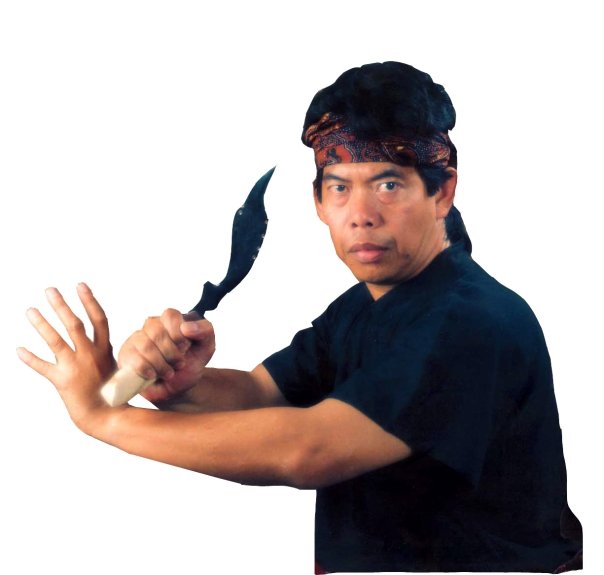
Kujang: The Blade of Sunda (Part 1)


Hello again everyone.
Well I've been threatening you all with it for a long while, but it’s finally here, a full two perhaps three articles on my favourite weapon the Kujang. I would firstly like to dedicate this article to my first Kujang students Max and Matt (This ones for you guys); and to their Main teacher a highly skilled, wise generous man and a good friend. You know who you are!

My aim in this series is to give an informative and illustrative introduction to the kujang sometimes called Kudi (In Javanese) I wont stray into the academic "mine field" which is related to the history and the uses (or not) of the kujang there’s just to many people, with there own opinions, agendas etc to satisfy. I will include at the footer of this article, for those that want to "Go there" a list of links to some great articles relating more to the history and origins of the kujang. I’m not a scholar of classical Indonesian history and will leave that debate to fester on its own it’s done just fine before I was around and will no doubt continue long after I’m gone.

I want to focus on the uses of the kujang in our system of Pukulan Cimande, my expression of that system in Pencak Silat Seni-Sunda, its relevance as explained to me through that lineage, to the Sundanese people, and to its animal links etc. This is a beautiful ancient weapon and very overlooked as I will hope to show you. Article two will look at some drills and buah taken from our "Cutting drills" and Juru-juru.

 A Story :
Here is one old legend of the kujang It starts with King Prabu Siliwangi of  Pajajaran kingdom in the 12th century (Western calendar) and his two sons. The older son was Prince Radan Komondoko. The Younger son's name has been lost in history . The story goes that the elder son was sent into the Jungle to train with a master of ilmu(magick) Pencak Silat and he carried the blade that his father . King Silawngi had created to roughly resemble the shape of the island of Java, or Djawa Dwipa as it was formerly known at that time. Some also belive that the shape resembled the root and bulb of a plant and is a reminder to the farmer orgins of the Sunda people. Some say the name was Prabu Kudo Lalean of the King who invented this shape but I have not heard this from any of the old Masters who always told me the former name. Now back to the story . The elder son met the master in the jungle and this man had young daughter who over time became the adopted sister of Radan Komondoko. Decades later the younger son ventured into the same area and came across the now older daughter of Radan Komondoko's teacher. He became interested in her and was flirting with her when along came his older brother . He did not recognize his younger brother and believed he was disrespectful to his adopted sister so he challenged his own brother to a fight. The younger Brother had also been studying his Pencak Silat and Ilmu very diligently and the fight as legend tells it went on for days . When neither could win they decided to use weapons and each pulled there fathers Kujang . At once they realized they were brothers as these were at that time the only two kujangs in existence given to them by there father,  They were happy to see each other and joined forces with there knowledge together of Pencak Silat Kujang fighting and Ilmu. From that point on their methods became the inheritance of kujang in Some Pencak Silat schools.

This is a quaint story there are many involving the Kujang and its place in Sundanese collective consciousness, a story of lost brothers re-uniting to mirror the plans of any ruler to re-unite various tribes into a strong and unified nation. The kujang are often fashioned with the body of a tiger and or in scabbards resembling the tiger. I was told that the tiger was a symbol of the ancient Sundanese peoples to whom it had totemic significance, although is is probably no longer remembered this is the reason, which is now done this way through tradition , a tradition who’s origin as been forgotten or eroded by Islamification at a later date.

Designs:
While I made mention that I wouldnt be drawn into history and exact origns of the kujang as there are none at least definitive as yet We know that the kujang originated probably from an agricultual tool used for cutting grass and for tiling the soil a reminder to the Sundapeoples of their agricultural origns and this may give relevance to the notion that the blade originaly was modlled on the root or bulb of a plant. Some stories claim that the blade was forged after a vision of the island of Java and the stories continue.
There are a myrid of different kujang designs, but today they basicly come down to two main types with two distinct historical roots. The original kujangs or Proto-Kujang are found on stone relifs of great antiquity circa 4th-7th centurys AD (Western calenda)  the original "True" kujang where belived to be of Hindu or even Budhist origins, these are sometimes called Pusaka kujang due to their great age, these are distinqued my sutlties in the shapes but mostly by the number of holes found in and around the blade the oldest kujang have three holes which is said to relate to the Hindu trinity of Brahma, Vishnu, and Shiva. Latewr Islamic kings Imans etc wanting to spread Islam changed the blades shape made wider to resemble the Abrabic letter "Syin" and they changed the number of holes (sometimes filled with gold) from the Hindu trinity to five to represent , some belive the 5 pillars of Islam. In our system the number five equates to the four animal mannerisms and the fifth being "Raja Naga" the blend of the other four animals.

Lineage:
The Kujang I studied as come to me through my Sut Guru, Guru Besar Liam McDonald. Who studied directly under Pendekar Sanders, Pendekar Sanders in turn learnt his kujang directly from the late Pendekar "Eddie" Jafri and from Pendekar Mama Sukarma. In the system of Pukulan Cimande Combat (Guru Besar Liam McDonalds expression) of Pendekar Sanders style there are two main areas of kujang study. One is the 10 Kujang Jurus, given to Pendekar Sanders from Pendekar Jafri and secondly the Latihan Permangkasan "Cutting excersises / drills." I practiced the  the former for several years and now whilst I do teach beginners the kujang Jurus which contain some wonderful concepts and cleaver techniques I personally prefere the latihan permangkasan. The aim here as with all things is to learn and drill the kujang movements from the juru and then forget the framework and keep the concepts, my rational for prefering the latihan permangkasan is that they have a two man element to them so your working on things like ranging to hit a moving target and working with anothers energy etc and because they are less static, but its horses for courses learn the rules and forget the tools.
Talisman or Tool:
One major debate which as scholars and persilats at each others throats is the view that the kujang is'nt or never was used as a weapon! there is a very hard core group that claim that kujangs are only ever meant to be used in ritual. Its true that there is a powerful cultural link with the Sunda peoples and the kujang and yes it was used in rituals of fertility and as a tool to communicate with our ancestors, there are rituals for cleaning and feeding the kujang and yes it was used in talismanic manner very similar to the Javanese Keris; but it is in my mind and many other much high skilled persilats a weapon.
Thye Sunda where and still are at heart a practical and pragmatic peoples skilled warriors with strong agricultural roots streaching back for thosands of years. So would these people ONLY use items for ritual or would they "multi task" and use a sharp iron or bronze multi blades sharp tool as a weapon too? OF COURSE THEY WOULD AND DID AND DO STILL!

There is an element in Indonesia today that over emphasises the spiritual practices of Pencak Silat and its trappings telling us that kujang and Keris where just for status and ritual. Ok Im a "dumb white guy" trained by other white guys but they where taught by native Indonesians of imense skill many where native Sunda so did they have it wrong too? was Pendekar Jafri, Pendekar Mama Sukarma and even the greatest persilat of the last few decades Pendekar Herman Suwanda all wrong? all lying? "ummmm" proably not. Do people over press the spiiritual aspects of an art because they no longer know how to use the object anymore OH YES.

And yes the kujang is a mystical object In the Kujang there are PusakaTayuhan comprising what is called "isi" or "Tua" or Magick in the blade.  The real Pusaka can take months or even years to create. It is normally constructed with layered metals called Pamor and is filled with "tua" or "isi (magickal power) by the maker using various methods of fasting and mantra repeated over the blade while it is being made. From the occult side, like the keris, another weapon used by the indo-malayan natives, the kujang was often consecrated with magickal power and familiar spirits attached for specific purposes, such as the protection against psychic attack. Because of the inherent power of the kujang in conjunction with the presence of its spirit guardians, the well-informed natives revere them as sacred objects. But they are also weapons! Old pre Islamic relifs depicted the use of Kerises and proto-Kujangs in combat. Also some of the folktales and historical events are clear that both weapons are used as weapons. Saying Keris and Kujang were just Talisman is the same as saying that wearing Katanas and Wakizashis are just symbols of the samurai, both weapons are not weapons but status badges.

Nowadays, the kujang is often decorated in homes as it is believed to bring about luck, protection, honor, etc. They are displayed in pairs on walls with the inner edge facing each other. There is a taboo, however--no one is to be photographed standing in-between them as this would somehow cause the death of that person within a year. Why this occurs is not known for certain, we might shrug it off as superstition, coincidence or synchronicity but behind every phenomenon cosmic laws and intelligences are at work; we just need to discover what those laws are and the mind-set of those metaphysical intelligences directing those laws to know the reason for the anomaly.

So hope you enjoyed the article and next part will cover more practical uses and some clips of kujang buah.
Till then train hard, play safe ;)